The Fundamental Shift: Conversation Over Documentation
Modern Agile practice highlights a hard truth: a user story written by a Business Analyst (BA) in isolation is already at risk of failure. The problem is not poor formatting or missing components.
The deeper issue is that a user story is not meant to function as a static document; it is meant to start and support a conversation. From a curriculum design and coaching perspective, this is a critical lesson for every team.
A productive requirements conversation cannot happen in isolation, and even a polished story drafted in a vacuum often reflects a weakness in process rather than strength in analysis.
To move from a document mindset to a conversation mindset, teams often use the Three C's framework:
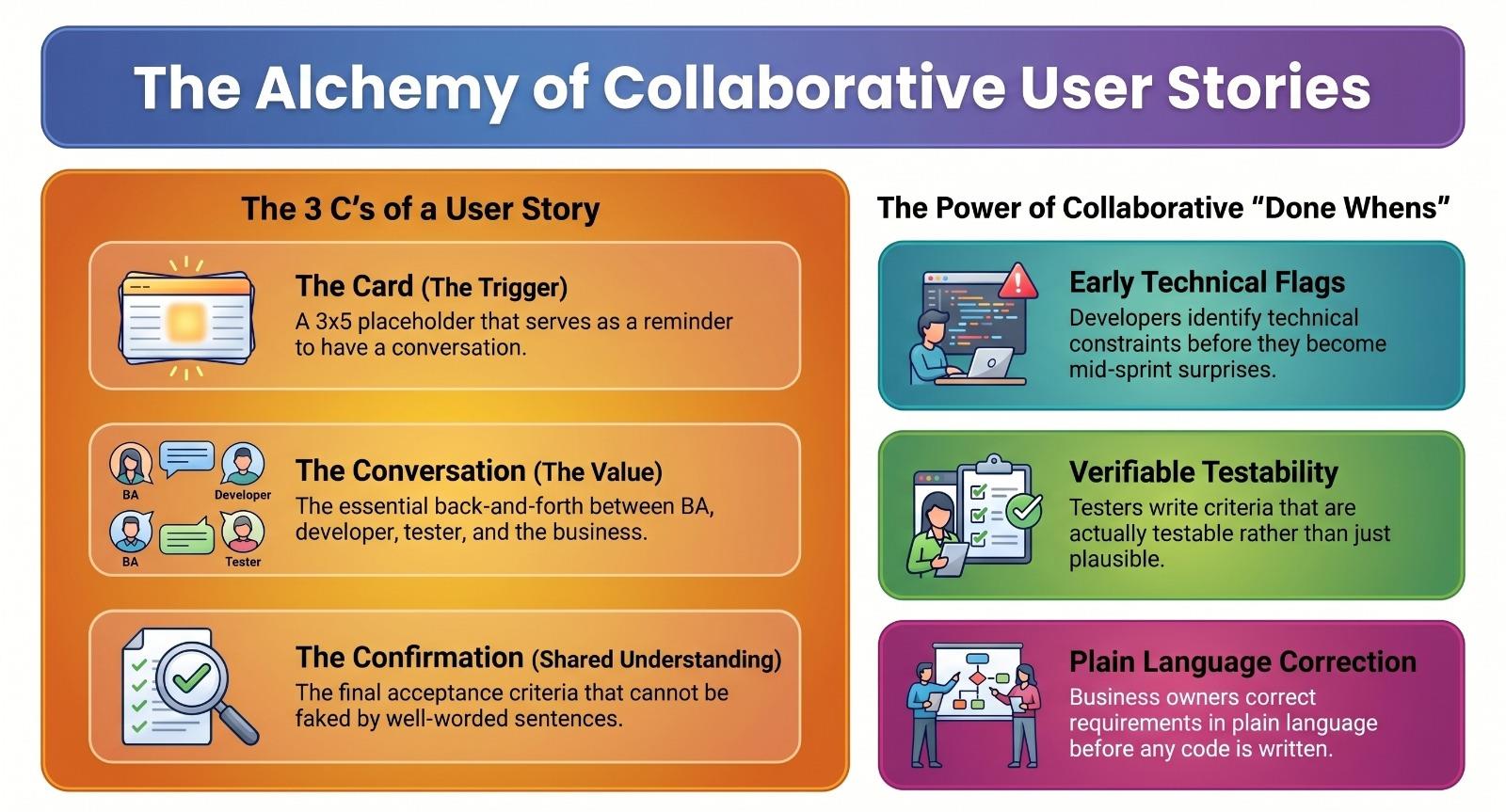
The Card: This is not a requirement; it is a trigger. It is a 3x5 placeholder that signals, "We need to talk about this."
The Conversation: This is where the actual value is generated. It is the iterative back-and-forth between the BA, the developer, the tester, and the business owner.
The Confirmation: This is the shared understanding that remains after the talk - a result that cannot be faked by even the most articulate solo writing.
As many Agile practitioners caution, the risk is simple:
Skip the conversation, and what remains is a beautifully formatted assumption.
This shift also changes the role of the BA. Rather than acting as a solitary creator of artefacts, the BA becomes a facilitator of dialogue, helping the team build shared understanding and move toward a common goal instead of pursuing separate interpretations.
The “Three Lenses” Conflict: Why Solo Writing Fails
When requirements are drafted in isolation, they are inevitably filtered through a single perspective.
Once that document is handed over, the rest of the team interprets it through their own professional lenses.
Without a collaborative discussion to reconcile those viewpoints, misalignment becomes almost inevitable.
Role | Perspective / Lens | Risk of Isolation |
Business Analyst | Writes what they understand. | They document a business need that may be incomplete or misinterpreted. |
Developer | Focuses on what they can build. | Technical hurdles and constraints remain hidden as "mid-sprint surprises." |
Tester | Focuses on what they can verify. | They find the requirement is impossible to actually prove or test. |
The implication: When these three lenses diverge, the tension often surfaces most sharply during User Acceptance Testing (UAT). If the BA, developer, and tester have never aligned their perspectives, UAT becomes a stage for avoidable surprises.
In a professional Agile environment, no one should be surprised at the end of a sprint. Surprises in UAT are usually evidence of misalignment that was built into the requirements from the beginning.
When these lenses are aligned through collaborative working sessions, the criteria themselves begin to evolve from a personal wishlist into a team-owned delivery plan.
From Isolated Wishlists to Collaborative Criteria
The difference between a wishlist and meaningful acceptance criteria lies in team ownership. A common trap occurs when a BA writes a story alone and then asks the team to review it. Review is passive. Strong acceptance criteria, or Done When statements, are most effective when they are shaped together in real time. This is not merely a preferred practice; it is a hallmark of professional requirements work.
There are three primary benefits when a team owns the criteria:
Early Identification of Technical Constraints: Collaborative writing allows developers to flag technical hurdles immediately, preventing them from derailing the team mid-sprint.
Testability Over Plausibility: Solo requirements often sound plausible on paper but are functionally impossible to verify. Testers ensure that "Done When" statements are actually testable.
Plain Language Correction: When a business owner hears their requirements reflected back to them in plain language by the team, they can correct misunderstandings before a single line of code is written.
Collaborative dialogue does more than refine existing ideas; it brings missing assumptions, overlooked constraints, and hidden risks into view before delivery begins.
The Power of Negative Criteria
One of the most valuable outcomes of collaborative requirements writing is the discovery of negative “Done Whens”: statements that define what the solution must not do.
When working alone, a BA often focuses on the happy path. Developers and testers, however, bring the practical experience needed to identify the boundaries, failure points, and unintended consequences that should be addressed early.
Why this matters: Negative “Done Whens” help define the boundaries of safety, compliance, and technical reliability. They establish the essential must-nots that protect a project from avoidable risk and future technical debt.
For example, when a financial adviser scopes an AI analysis tool, the initial wishlist may focus on speed and convenience. A collaborative session with developers and testers is more likely to surface a crucial negative criterion: the tool must not compromise client confidentiality or store unencrypted personally identifiable information.
This discipline of defining negative criteria is a mark of professional requirement-setting and applies across industries, from software delivery to financial services, wherever tools are being designed for human use.
The Cost of Isolation
When teams skip the conversation, they take on a form of project debt that will almost always need to be paid later. The warning signs typically appear across the delivery lifecycle:
At Requirements: The team is working from "beautifully formatted assumptions" rather than a foundation of shared understanding.
During Development: Developers are constantly hitting "hidden" constraints that force them to stop and re-plan mid-sprint.
During UAT: The business, the developers, and the testers realise - too late - that they each had a different interpretation of the same sentence.
Ultimately, success for a BA or delivery lead depends on the ability to facilitate shared understanding.
When the right people are brought into the conversation before a requirement is treated as complete, a fragile solo wishlist can be transformed into a robust, realistic outcome that the whole team is prepared to deliver.